Common system failures

Where dealership
marketing breaks.

Most dealership marketing did not fail all at once. It became disconnected one decision at a time.

A vendor installed the website. Another manages the ads. The CRM was configured years ago. Lead sources stopped matching reality. Co-op deadlines passed. Reports kept arriving, but nobody could clearly connect the activity to what happened in the dealership.

Elite Powersports Consulting brings those systems back together. We audit the full marketing and lead-flow operation, repair the highest-impact gaps, establish clear ownership, and monitor the system so the same problems do not quietly return.

54%

of dealership website traffic happens outside business hours. You paid for that click. If nothing catches it overnight, the customer is gone by morning.

47%

of powersports dealers answer a website customer’s question at all. Automotive manages 78%. More than half of inquiries industry-wide are still sitting untouched a full day later.

60%

of dealerships stop following up after three days of non-response, and 15% make only a single automated attempt. The deal goes to whoever is still working the lead on attempt five, not attempt one.

Traffic: Dealer Spike, The State of the Dealer: 2026, observed across 6,800+ dealerships. Response: Pied Piper PSI 2026 Internet Lead Effectiveness Study, inquiries submitted through 2,133 powersports dealership websites. Follow-up persistence: Tecobi lead-response analysis (dealership CRM vendor).

Store size doesn’t predict any of this. Some of the widest gaps we have walked into were inside some of the largest dealerships in the country. It runs the whole range, from the highest-volume retailers down to the family-run single location. Volume covers a lot of ground, right up until it stops.

Common system failures

L—01

Spend grows. Clarity does not.

The budget increases, but lead quality, sold-unit attribution, and cost efficiency remain unclear. Everyone can show activity. Nobody can confidently show which activity influenced revenue.

More spend. Same uncertainty.
L—02

Traffic arrives. Opportunity disappears.

Customers reach the website, struggle to find the right inventory or next step, and leave without calling, submitting a form, or viewing the unit that brought them there.

Paid traffic should not hit a dead end.
L—03

CRM reporting stopped matching reality.

Sources, sub-sources, campaign names, and lead routing were configured years ago — or differently by every vendor. The reports look complete, but the attribution underneath them is unreliable.

Bad inputs create confident, wrong decisions.
L—04

Response depends on who is working.

A weekday inquiry gets handled quickly. A night or weekend inquiry sits untouched. Follow-up quality changes by employee, shift, department, and location.

The buyer’s timing should not decide whether the lead gets worked.
L—05

Co-op funds expire unused.

Eligible advertising dollars are lost because nobody owned the approval, documentation, proof, submission, or deadline from beginning to end.

Available reimbursement is not recovered reimbursement.
L—06

Reports describe media, not the business.

Clicks, impressions, CTR, and reach matter, but they are not the finish line. Leadership needs lead volume, lead quality, source accuracy, co-op recovery, appointments, sales influence, and cost efficiency.

A media report is not a dealership operating report.

The Elite Powersports Consulting model

One operating plan.
Checked continuously.

Most dealerships operate through several platforms and vendors that each see only their own piece of the business.

Elite Powersports Consulting connects the pieces: advertising, inventory, website conversion, CRM attribution, lead handling, co-op, reporting and vendor execution. Each system keeps its proper role, but the decisions get made from one coordinated operating plan.

We monitor the leading indicators, surface problems early, and give the dealership a clear view of what needs action, who owns it, and what happens next.

SYS / 01 — Paid Media

Every dollar has a defined role

Google, Meta, YouTube and supporting media are organized around actual inventory, buyer demand, OEM programs, dealer-led priorities and trackable customer actions.

Budgets are not spread evenly because every campaign exists. They are assigned by purpose, funding source, segment, season and performance.

  • Google Search and Performance Max
  • Meta’s three-pillar framework
  • Inventory and vehicle-feed campaigns
  • OEM and dealer-led budget separation
  • Weekly pacing and waste review

Lower cost per lead across a five-rooftop Harley-Davidson group,
with the strongest rooftop improving by roughly one-third

First-person view of a shopper holding a phone showing a side-by-side listing and its price01
From the first search to the showroom conversation

SYS / 02 — CRM & Lead Flow

Every lead should have a traceable path

We audit source and sub-source configuration, lead routing, response timing, follow-up coverage and CRM stage progression.

The goal is not merely to create more inquiries. It is to make sure each opportunity enters the right workflow, reaches the right person, and can be followed from first interaction through the dealership’s sales process.

  • Source and sub-source correction
  • Lead-routing validation
  • Nights and weekends coverage
  • Response-time measurement
  • CRM funnel and leakage reporting

27% year-over-year lead-volume growth
at a multi-rooftop powersports group

A salesperson in a dealership polo shaking hands with a customer beside a new motorcycle02
The showroom outcome the marketing system was built to create

SYS / 03 — OEM Co-op & MDF

Turn eligible activity into recoverable reimbursement

We coordinate co-op campaigns from planning through documentation: OEM-funded activity separated from dealer-led activity, campaigns built to the applicable program requirements, proof collected, invoices and platform reporting organized, and packet readiness tracked before submission deadlines.

The OEM remains responsible for final eligibility, approval and reimbursement. Our job is to remove the preventable failures — missing proof, mixed funding, non-compliant creative, a deadline nobody owned.

  • OEM-specific campaign separation
  • Pre-approval support when required
  • Proof and invoice organization
  • Claim-ready submission packets
  • Monthly and quarterly deadline tracking

Initial audits frequently uncover eligible activity or available
funds that were not being actively tracked.

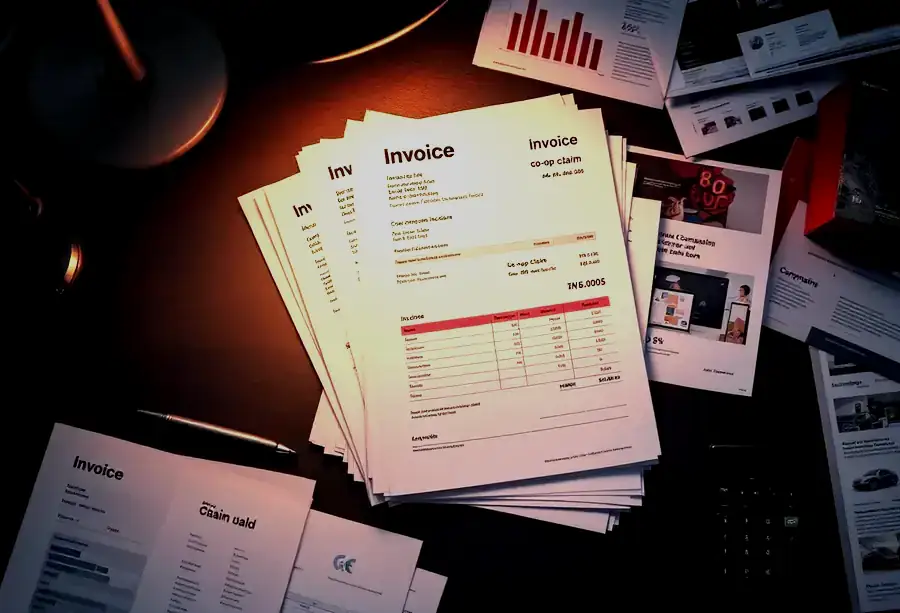
Co-op claim paperwork, ad proofs and invoices laid out on a desk03
Campaign proof organized to program requirements

SYS / 04 — Vendor Coordination

One operating owner across disconnected tools

Your website, CRM, DMS, chat, digital retailing tools, inventory feeds, call tracking and reporting platforms all affect the customer journey.

We assist your team or take the lead outright — your call. Either way we coordinate the work across those systems, document ownership, follow open issues, and keep vendors accountable to the dealership’s operating plan.

  • One coordinated issue list
  • Vendor and platform follow-through
  • Settings and integration reviews
  • Feed and tracking escalation
  • Clear responsibility and handoff

You already pay for the technology.
We help make sure the technology is doing its job.

A dealership marketing manager on a headset working through vendor settings04
One operating plan across the technology stack

SYS / 05 — Market & Competitor Intelligence

Understand the market before funding the message

Before recommending a strategy, we study the dealership’s actual operating environment: its rooftops, competitors, brands, inventory priorities, customer segments, geography, website journey, social presence and lead process.

Where appropriate we also run controlled inquiry testing, to understand how the current lead flow behaves from the customer’s side of it.

  • Competitor mapping by rooftop
  • Primary and secondary market review
  • Website and conversion-path analysis
  • Social and messaging review
  • Controlled lead-flow testing

The audit replaces assumptions with a documented view
of the dealership’s market and systems.

A marked-up map, competitor listings and a market chart on a desk05
Know the market before deciding where to spend

SYS / 06 — Dealer AI & Automation

Automation watches the system. People make the decisions.

We use dealer-specific AI and automation to monitor the recurring operational signals: spend pacing, feed health, tracking status, campaign delivery, lead-source changes and reporting readiness.

Automation surfaces the issue faster. Experienced operators determine what the signal means and what action should follow.

  • Automated account health checks
  • Tracking and feed monitoring
  • Spend-pacing alerts
  • Reporting and proof workflows
  • Human review before material changes

Faster detection. Cleaner handoffs.
Human accountability.

A laptop showing an overnight alert dashboard in an empty showroom at first light06
Watching the operating signals before they become expensive problems

Dealer leak model

See where the system
loses momentum.

Enter your monthly traffic and advertising spend, then adjust one funnel stage at a time to see how changes in capture, response, appointment and close rates affect the modeled outcome. This is an educational model built with illustrative assumptions. It is not a forecast, guarantee, valuation, or substitute for an audit using your actual website, CRM, media and sales data.

Illustrative unit outcome
0
Modeled leads captured
0
Modeled media cost per unit
$0
Spend reaching the modeled funnel
$0
Illustrative opportunity gap
0

Illustrative model only. Stage rates are generalized assumptions informed by powersports dealership funnels and are not a prediction of your results. Actual performance depends on inventory, market conditions, media mix, website experience, CRM configuration, lead handling, pricing, sales execution and other factors. A Dealer Growth Audit uses your actual systems and data.

The first 90 days

Audit first.
Build second.
Optimize continuously.

The sequence matters. We do not begin by launching more campaigns into a system we have not validated. The first 90 days establish the source of truth, correct the foundation, activate the plan, and create the operating rhythm used from there on.

First Gear

Audit

We document the dealership, its rooftops, OEMs, market, competitors, technology, media accounts, website journey, CRM configuration, lead flow, tracking, co-op programs and known operational gaps.

Deliverable: Dealer Growth Audit and prioritized action plan

Second Gear

Rebuild the foundation

We correct the highest-impact issues first: conversion tracking, source attribution, lead routing, feed health, campaign taxonomy, OEM separation, landing destinations and reporting structure. Budgets get assigned from the approved plan — not invented percentages or a generic agency template.

Deliverable: validated marketing and lead-flow foundation

Third Gear

Activate and optimize

Campaigns launch or transition into the approved structure. Spend, lead flow, feed health, tracking, search terms, pacing and creative performance are reviewed on a defined cadence. Winners earn additional opportunity. Underperforming activity gets diagnosed and corrected before larger structural decisions are made.

Cadence: daily monitoring, weekly optimization reviews

Fourth Gear

Report what you can act on

The monthly review connects media activity to business outcomes as far as the available data reliably allows: spend, lead volume, lead source, cost efficiency, OEM performance, co-op readiness, operational issues — and, when clean sales data is shared, cost per sold unit and downstream performance.

Cadence: monthly review, with issue escalation as needed

Fifth Gear

Scale what earned it

Once tracking is stable and the economics hold, we expand intentionally: additional budget, new product segments, stronger lifecycle campaigns, new rooftops, or deeper automation. Scaling follows verified capacity and performance — not simply the fact that more budget is available.

Trigger: stable tracking, proven demand, supportable unit economics

Stop guessing.
See the system clearly.
Request a Dealer Growth Audit →

The audit documents your rooftops, market, competitors, media accounts, website journey, CRM configuration, lead flow, tracking and co-op programs — and hands you a prioritized action plan for what should happen first.